It’s a street food so iconic that it has its own flavor of potato chips, a song, Google doodle and a museum. The Currywurst is a memorable part of most service members and their families’ experience in Germany. But did you know that flavors loved by American and British Soldiers aided in the birth of this snack?
I didn’t. I’m a German-American Air Force brat and my very first memories of my life are of living in Berlin with my grandparents while my dad did a one-year remote tour in Thailand during the Vietnam War. Just the thought of a Currywurst makes me drool and immediately brings back fond, childhood memories of Berlin. It’s a pretty basic dish (Bratwurst with a curry-flavored ketchup sauce), so I thought I pretty much knew everything about it. Wrong!
My curiosity compelled me to visit the fairly new Deutsches Currywurst Museum (www.currywurstmuseum.com) a few years ago and I was amazed with what I learned. Not only was Currywurst invented in my mom’s home district of Berlin-Charlottenburg, but its creation was influenced by allied Soldiers. My relationship with Currywurst became extremely personal. It’s a microcosm of my heritage on a paper plate.
According to the Deutsches (German) Currywurst Museum, it’s no coincidence that the invention of the Currywurst is rooted in the unique environment of post-World War II Berlin. There was less to eat then and everything was in short supply. The allied forces brought new influences and unknown food items to the city, such as American-style ketchup and English curry powder. Curry was a relatively unknown ingredient in German cuisine at the time. People became creative with the little that was available.
Berliner Herta Heuwer definitely got creative with some of these new ingredients and concocted a unique sauce. She sold her first Currywurst on Sept. 4, 1949. Her snack stand was located at the corner of Kant and Kaiser Friedrich Strasse in Charlottenburg, a western borough, and she named it “First Currywurst Roaster in the World.” She patented her “Chillup Sauce” in 1959. A food phenomenon was born.
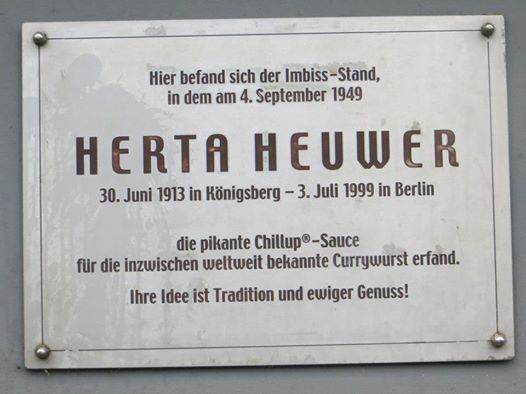
My obsession with the taste of Berlin grew even stronger when I learned that the Currywurst was invented in my mom’s home district of Berlin-Charlottenburg. In fact, the first Currywurst stand was right around the corner from where I used to go shopping with my Oma.
Currywurst is an urban food, a factor in the economy, an icon and it’s hip. It’s part of Berlin’s cultural heritage, has been celebrated in films and books and is a source of inspiration for artist, authors, musicians, movie makers, gourmets and the media. This spiced sausage snack has generated many curry-scented memories for Americans who have served in Germany.
“Imbiss (fast food) stands were everywhere in Berlin,” says my dad, retired Air Force Col. Harold Linton, who first ate Currywurst during his assignment to Tempelhof Air Base as an Airman 2nd Class in 1960. “There was one at the corner of Columbia Damm and Tempelhofer Strasse and I would eat a Currywurst right before I headed back to base after a night on the town. Everyone, it didn’t matter if you were rich or poor, ate Currrywurst.” My dad and my mom Ingrid, who is from Berlin-Charlottenburg – birthplace of the city’s favorite sausage – agree that the taste of Currywurst and its easy availability in the city make it an important part of their Berlin memories.
My hometown Sierra Vista in southeastern Arizona seems like an unlikely place to find a Currywurst on the menu, but it isn’t really surprising given the Soldier influence on food here. After all, the world’s first McDonald’s drive-through was created here because of an order in the early 1970s restricting Soldiers from patronizing local business while wearing their uniform. A Currywurst on the menu of a local German restaurant makes good business sense here.
“Currywurst is a popular dish, not only all over Germany, but also here in the U.S in our German restaurants. Currywurst with french fries is one of the most favorite dishes in the café. We have such large requests that we started making our own curry-sauce, using a German recipe,” said Annette Engols, owner of the German Café.
Fort Huachuca employee Rafael Monge lived in Nuernburg as a family member in 1979 and 1980, and later served his first tour in the Army at the airfield in Giebelstadt from 1987 to 1993. “An Imbiss truck would drive on to the base and park between two barracks. The guy who ran it was named Jimmy, so the Soldiers called it the Jimmy Truck,” says Monge. “As it got closer to payday and money was tight, we would rifle through our change jars to come up with the 3 Deutschmark to buy a Wurst.”
Retired Army Sgt. 1st Class Dexter Marquez who also works on Fort Huachuca, enjoyed a close relationship with Currywurst during his assignment to Armed Forces Network Berlin from 1989 to 1994. Then a young private first class, he remembers his sergeant taking him to the Kudamm shortly after his arrival to get to know the city and enjoy some night life. Near the Gedächtniskirche on the Kudamm, the sergeant bought Marquez his first Currywurst at an Imbiss stand. “Holy cow! I immediately fell in love and thought this is the greatest snack of all time,” said Marquez. “I ate four more after the first Currywurst!” A love affair begun, Currywurst was in heavy rotation in his diet during his years at AFN Berlin.
Currywurst has inspired many service members’ treasured memories of Germany and has legions of fans all over the world, but what lead to the creation of its own museum in Berlin? “The idea first came up during a holiday trip to Jamaica. Martin Löwer, the initiator and curator, visited an exhibition about the yam root which is a typical national food item there. By thinking about something similarly popular in Germany and especially Berlin, the idea of the Deutsches Currywurst Museum was born,” says Bianca Wohlfromm, director for Community and Media Management at the museum.
Research on the topic began in 2005 and the exhibition featuring the Currywurst finally opened in August 2009. The interactive museum tells all aspects of the Currywurst story, encouraging visitors to use their sense of sight, hearing and smell, and of course, finally taste. The Deutsches Currywurst Museum is the recipient of five design awards.
“The success story of Currywurst is a phenomenon. Due to the history, it is part of Germany’s cultural heritage. But no other fast food has ever been such an inspiration for songwriters, authors, comedians, artists and their different requirements. Currywurst represents simplicity and honesty, being in the world, down-to-earth – but yet special. This is one reason for picturing celebrities or politicians with a Currywurst,” says Wohlfromm. “It made a culinary career – the Currywurst as a snack stand, fast food product served on a paper plate is a respectable dish at gala events nowadays, usually served on a porcelain plate in the shape of the traditional paper plate. There are even luxury versions served with gold powder or gold leaf on top available from time to time,” Wohlfromm adds.
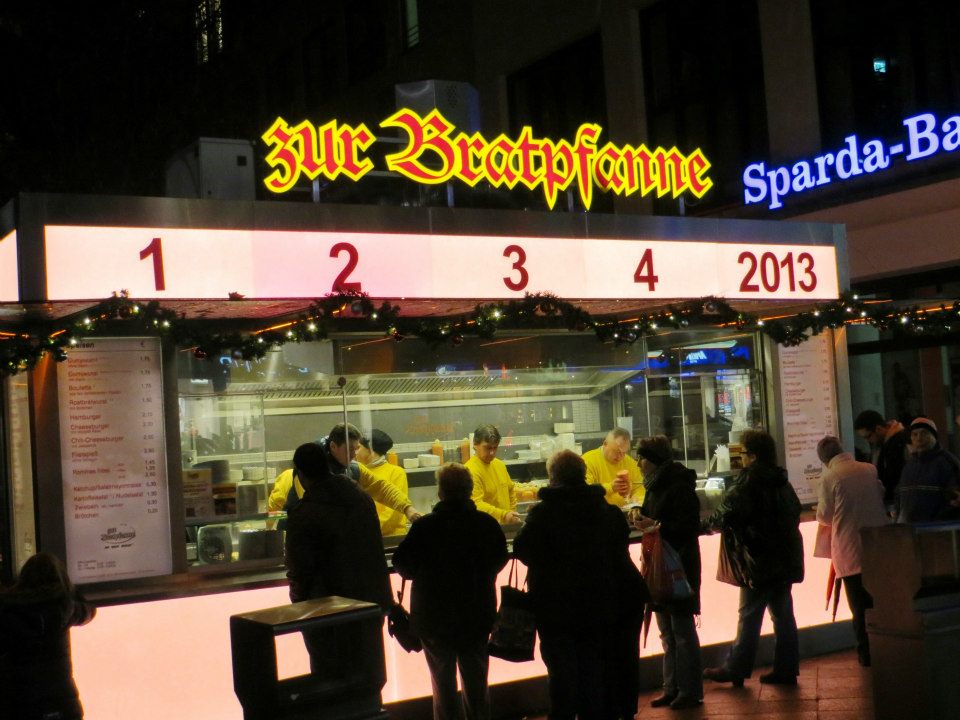
Zur Bratpfanne on the Schlossstrasse in Berlin-Steglitz is a favorite place to enjoy a taste of my Berliner heritage after some retail therapy. It’s popular with taxi drivers and this Imbiss stand with its classic menu is always busy.
With the fall of the Berlin Wall and the end of the Cold War, allied forces departed Berlin by September 1994. The legacy of thousands of American and British service members who served in the city and Berliner ingenuity will always be celebrated every time ketchup and curry come together on top of a German sausage served on a paper plate anywhere in the world.




 Compelling Curiosity