Discovering a Borderlands Community in Arizona

My husband and I headed to Camp Naco in southern Arizona on a Saturday morning to see where Buffalo Soldiers played baseball and learn about the outlaw Cactus League formed in 1910. Like many historic locations, the actual structure is long gone but a gifted storyteller skillfully laid out historical facts along with a few artifacts to help us to visualize the field. 

After viewing the field, we got in our cars to drive to the elementary school in the small town of Naco for his formal presentation.

This was a first for me. Naco is a place I typically drive past on a visit to Bisbee. I have an awareness that a small number of people live there but that’s pretty much it. While navigating the streets to the school, I catch a glimpse of a Mexican flag on the horizon.

The Mexican flag flies over Naco, Sonora on the southern border.

The baseball presentation was very interesting, even for a person like me who isn’t particularly into the sport. It helped me understand the popularity of a game in small towns across America and Mexico during a time without radio, television or internet.

An hour later it was time to get back in my car and drive home, but I wanted a closer look at the Mexican flag I had seen earlier. I didn’t have far to travel. Less than a block away was Towner Street which leads to the Naco Port of Entry.

I live in southern Arizona. The idea that our shared border is part of the landscape is something those of us who live here are familiar with. I used to drive to Nogales, Arizona (about 45 minutes away) to walk over to Nogales, Sonora for a quick shopping trip and lunch. I haven’t done that in more than 15 years. I live in the southeastern corner of the state in Cochise County. I drive through a Border Patrol checkpoint inside the U.S. every time I head to Tucson. It’s not uncommon to see their vehicles in the streets here. Over the past five years it’s become a regular thing to see them in high speed pursuits of human smugglers through our communities. Turns out that most of these drivers are American teenagers recruited on social media with the promise of $1K per head. Some aren’t even old enough to have a drivers license and their sketchy driving while being chased by law enforcement has lead to serious accidents and even a couple of deaths. 

Just up the road from my home is the Army installation I worked on for more than 25 years. It is now the headquarters for the military southern border mission bringing an additional 500 Soldiers to my community and regular helicopter traffic. That’s not really all that shocking. In retirement I’ve taken up the mission of telling the stories of Soldiers who were here more than 100+ years ago to conduct a similar mission.
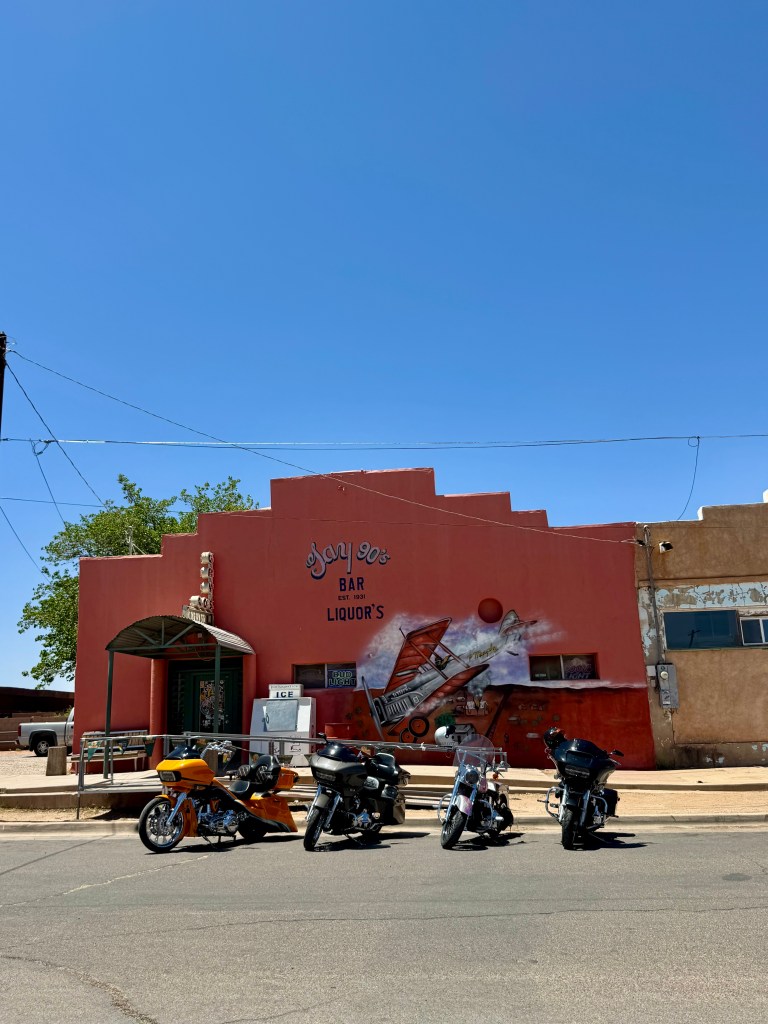
The Gay 90s Bar has been wetting border visitors’ whistles since 1931. A painting of Patrick Murphy’s accidental bombing of the town adorns the front of the building.

As I got out of my vehicle to walk down Towner Street to our border with Mexico, the view in front of me wasn’t seen through a filter of drugs, human misery, cartels and violence but one of small communities co-existing. I bumped into our baseball historian who invited me into the Gay 90s Bar for a drink and presumably colorful stories. Lou waited patiently in the car while I played documentarian so I asked for a rain check. Before I continued my stroll, the historian recommended a nice restaurant on the Sonoran side of the border and shared a story about a local entrepreneur who ran a bus service for Soldiers to visit the bustling red light district across the border. During Prohibition, visitors parked their vehicles on the Arizona side to cross over to Mexico.

Naco has earned an interesting historical footnote for being the first aerial bombardment of the continental United States by a foreign power. 

The incident took place in during the Escobar Rebellion in 1929. Rebel forces battling Mexican Federales for control of Naco, Sonora hired mercenary pilot Patrick Murphy to bombard government forces with improvised explosives dropped from his biplane. Miscalculating the locations of his targets, Murphy mistakenly dropped suitcase bombs on the American side of the international border on three occasions. This caused quite a bit of damage to private and government-owned property, as well as slight injuries to some American spectators watching the battle from across the border. A depiction of Murphy in his biplane adorns the wall of the Gay 90s bar commemorating the bombing.

When hostilities waned in the region, the Naco Hotel advertised its rooms as “bulletproof.”

The remnants of the Naco Hotel still stand. Once advertised as safe from violence on the Mexican side of the border, locals still refer to it as the Bulletproof Hotel.

Ghosts of boarded up buildings along a once busy street hint at a vibrant borderland. I look forward to coming back to the Gay 90s Bar for a thirst quencher and to learn more about the time Nancy Reagan visited and got a bit tipsy. Maybe with some liquid courage I’ll walk through the port of entry to eat a meal in Mexico.

I live in a place where everything the light touches is the border. It isn’t some distant, ominous presence making headlines. It’s a place populated with resilient people withstanding the winds of change and it’s much closer than I realized.

Faded signs on abandoned buildings line a formerly thriving thoroughfare.

I Didn’t Enlist, But I’m A Military Brat For Life

I am a bi-racial German-American.  Despite the several cultures hinted at in that sentence, the one I most identify with wasn’t even mentioned.  I am a military brat; an overseas Air Force brat to be more specific.

The Army started a campaign a few years ago to identify Army Veterans as Soldiers for Life with the motto, “Once a Soldier, always a Soldier.”  The idea is that time in uniform begins a lifetime of service.  Rightfully so.

In that vein, I like to think of military brats as Brats for Life (#BRAT4Life).  Once a brat, always a brat.  We were born into military families.   We didn’t put on the uniform.  We didn’t swear an oath.  We didn’t get medals.  But we served nonetheless.  Like dandelions, we bloomed wherever we were planted.  Those childhood experiences shape our adult experiences.  Some brats choose to follow in their parents’ footsteps and enlist in the military.  Others go into government service.  More still serve as coaches, teachers and mentors in their communities.

The U.S. Department of Defense conservatively estimates that 15 million Americans are former or current military brats. After 14 years of persistent conflict, more than 2 million American children and teenagers have had at least one parent deployed in a war zone. Nearly a million of them have had a parent deployed multiple times.

How do you recognize a military brat?  We almost always address someone senior to us or in uniform as “Sir” or “Ma’am.” We never leave the house without some form of identification with us.  We always stand at attention and face the nearest flag whenever the National Anthem is played.

Military kids have their own rich history that goes back to founding of our Nation.  Some social scientists have described them as one of America’s oldest and yet least well-known nomadic subcultures. History shows that military spouses and their children have been following armies for thousands of years, maybe for as long as there has been organized warfare.

No one really knows where the term military brat originated. Some think that it dates back to the British Empire hundreds of years ago and originally stood for British Regiment Attached Traveler.  Born, Raised And Transferred is a popular modern interpretation but I prefer Brave, Resilient, Adaptable, and Trustworthy. We may not agree on how the term originated and what it means, but it’s a term that military kids, especially when they reach adulthood, wear like a badge of honor.  It’s the way we identify with others who grew up the same way we did.

So often people talk about the sacrifices military children make. There is no question that being regularly uprooted and moved around to new places is challenging.  When I was a teenager, it mostly sucked.   I attended three different high schools. This was well before the advent of computers, smart phones and social media.  You knew that when you said goodbye to your friends, in most cases you would never see them again.  My generation of military brats made up for lost time and we are now all connected via Facebook.  It’s interesting to see who these kids grew up to be and it’s great to have a circle of friends who understand the whole brat experience and know where you’re “from.”

My Air Force Family taken some time in the late 80s when my dad was assigned to Stuttgart.

“Happiness is an Air Force Family” was a bumper sticker my dad had on his light blue Audi he nicknamed Air Force One. This picture was taken some time in the late 80s or early 90s when my dad was assigned to Patch Barracks in Stuttgart, Germany.

“It takes a village to raise a child,” is a popular phrase to describe raising a child. In the brat world that village is the military base your family is stationed at. I may not have realized it then, but it’s ironic now that my dad’s military specialty was intelligence.  When you grow up military, someone is always watching you.

I’ll never forget going on a date with a high school crush to the movie theater on base in Berlin.  After we stood up for the playing of the National Anthem (something that happens in all military theaters) and the lights dimmed, my date and I started making out like crazy.  As the movie ended and the lights came back up, the guy sitting two rows behind me said, “Hey, aren’t you Major Linton’s daughter?  I work with your dad.”  I probably turned 50 shades of red and wanted to sink into the floor. I sent up an immediate prayer to the guardians of teenage girls everywhere that this guy, who worked with my dad, wouldn’t say anything to him.  (For the record, he reported the encounter to my dad but not the details.)

Being surrounded by people who all know your parents and where they live and work isn’t necessarily a bad thing.  You maintain a situational awareness that someone may be “collecting intelligence” on you and reporting back to Headquarters Household.  It tempers some of the teenage hijinks and keeps them from veering into the dangerous or downright criminal.  The mere thought of my sponsor (parent in uniform) being called into his commander’s office to respond to an incident where there was a “failure to control his dependents” was enough to nip any extreme craziness in the bud for me.

Eventually, we brats grow up and and then comes that time when we turn 21 and the final military ID card expires.  It’s very traumatic.  I didn’t want to give mine up.  I held on to my ID card for months after it expired and was forced to give it up after a registered letter from an Air Force personnel office demanded I return it immediately to Bolling Air Force Base.  It felt like my membership to an exclusive club had been revoked and I was no longer welcome there.  Or so it seemed at the time.

The reality is that no one can ever take those experiences away from you.  You may no longer be a card-carrying member, but you have transitioned to being a BRAT4Life.  You are forever marked by the culture and environment that surrounded you since birth.  No matter which branch of service, which generation or even if you ever lived at the same military bases, you have something in common with every other military brat on the planet!

I work for the Army.  A year ago, I was in the office of our senior commander and took a look around at the personal memorabilia that decorated it.  My eyes landed on a framed black and white picture of an Airman in uniform and a desk plate for a tech sergeant with the same last name as my commander.  When there was an appropriate pause in the meeting I was attending I asked, “Sir, if you don’t mind me asking, is a member of your family in the Air Force?”  The Army two-star general responded that yes, his father had been an Air Force non-commissioned officer.  “Mine too!” I said.  I never in a million years would I have dreamed we had this common experience.  I later shared this story with my garrison commander and the colonel responded that his dad had also served in the Air Force.

The question, “Where are you from?” is the single hardest question for military brats to answer.  I’ve learned to answer with, “Well, I was raised in a military family . . . ” It’s not exactly a secret handshake but a fellow brat will always come back with a “So was I!”  Then we’re off to the races trying to determine if we were ever in the same place at the same time or high school football rivals in Germany.  It doesn’t matter if that person grew up in an Air Force, Army, Coast Guard, Marine Corps or Navy family, the homes we grew up in had similar values and we share similar experiences.

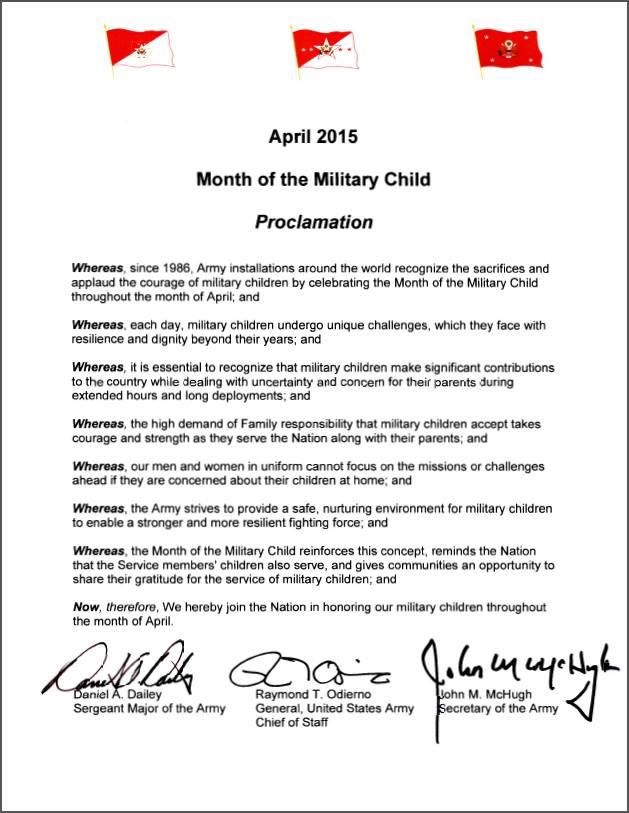
The way we military brats grew up makes us a little bit special.  So special that in 1986 the Secretary of Defense decided that one day to honor us wasn’t enough and created the Month of the Military Child.

MOMC Proclamation

The Army’s proclamation for Month of the Military Child.

April is Month of the Military Child.  Wear purple to demonstrate your support for military kids, identify yourself as a military brat, or do both!  Show your pride.  Celebrate your heritage.  Regardless of whether your battle cry is Hooah, Oorah, Hooyah, Air Power or Semper Paratus, this BravoRomeoAlphaTango FoxtrotOscarRomeo LimaIndiaFoxtrotEcho salutes you.  Once a military brat, always a brat.